
TOWERS is one of 1Win Games’ originals, built around climbing a virtual tower floor by floor. Each level puts you in front of a simple decision: keep going or take your winnings. The higher you climb, the bigger the multiplier — but the greater the chance of hitting a virus and losing everything. That tension between control and risk is exactly what makes TOWERS stand out from passive slot games.
What Is This Game
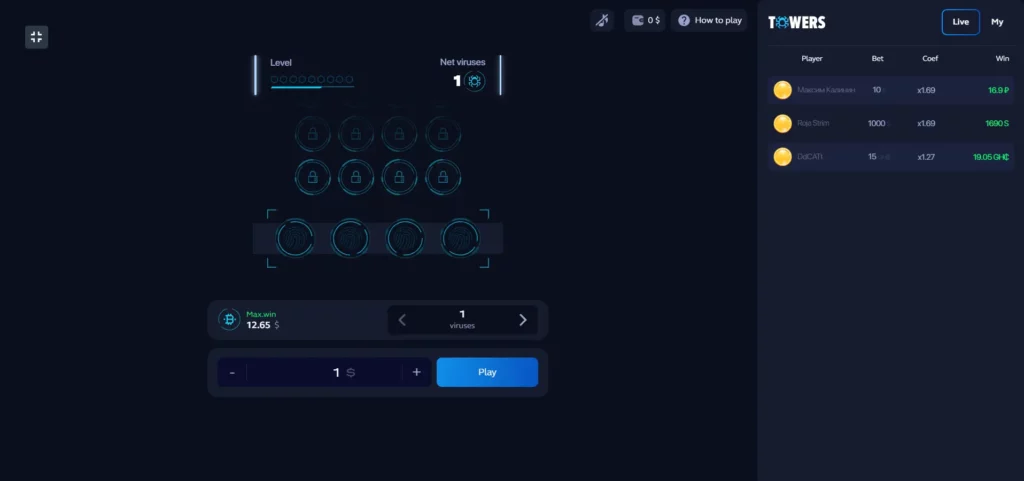
TOWERS is a tower-climbing game with a strategic element, where you ascend a 9-level tower. On each level, you pick one cell from a grid. Some cells hide a virus — hit one and the round ends with your stake lost. Pick a safe cell and you move up, with your multiplier growing as you go.
The defining feature of TOWERS is that you can cash out at any point during the climb without waiting to reach the top. That single decision — go further or walk away now — is the core of every round.
Bets range from $0.10 to $200, making the game accessible to cautious players and high-stakes players alike.

Towers
How TOWERS Is Structured
The tower has 9 levels. On each level, you are presented with a grid of cells and must choose one. The number of dangerous cells (viruses) per level depends on the difficulty you selected at the start:
Easy — 1 virus per level. The lowest risk, but the multiplier grows slowly.
Medium — 2 viruses per level. A balance between risk and potential reward.
Hard — 3 viruses per level. High risk, but the multiplier increases significantly faster with each level cleared.
Step-by-step breakdown of a round:
- Set your stake using the input field or the “+” and “−” buttons.
- Choose your difficulty — Easy, Medium, or Hard.
- Click Play — the first level of the tower appears.
- Select one cell from the row. If it is safe, you advance to the next level and the multiplier increases.
- On each subsequent level, select a cell again.
- At any point, you can click Cash Out to collect your current winnings.
- If you select a cell containing a virus, the round ends and your stake is lost.
- If you clear all 9 levels, you receive the maximum payout for that round.
All round results are stored in the betting history. You can verify the fairness of any result independently using the provided hash in an online generator.
How Risk and Reward Scale
The higher the difficulty and the further you climb, the larger the multiplier. This works in both directions — the reward potential grows, but so does the cumulative probability of hitting a virus on each additional step.
Example of cautious play: a player selects Easy, bets $5, and climbs to level 4 or 5 before cashing out. The multiplier is modest, but the risk of losing is low. Across several rounds, this approach can produce small but consistent returns.
Example of aggressive play: a player selects Hard, bets $20, and attempts to reach levels 7–9. Every step carries a real chance of losing the entire stake, but a successful run yields a payout well above the original bet. This style demands a willingness to absorb losses across multiple rounds.
Neither approach is inherently better. The right level of risk depends entirely on your bankroll and how much variance you are comfortable with.
When to Stop
Knowing when to cash out is the most important skill in TOWERS — and there is no single correct answer. A few practical principles can help guide the decision.
The further you go, the more you have to lose. At level 7 or 8, your multiplier is already substantial. Losing at that point hurts significantly more than losing at level 2. The higher you climb, the more it makes sense to ask whether the next step is worth the risk.
Set a target level before you start. Deciding in advance that you will cash out at level 5 or 6 removes the temptation to keep going purely out of momentum. This is sometimes called a stepped exit — you lock in a target and stick to it regardless of how the round feels.
Do not chase a loss with a longer climb. If you have lost several rounds in a row, the instinct is to push higher in the next round to recover faster. This usually leads to larger losses. Each round is independent — the tower has no memory of your previous results.
A simple stepped exit example: you decide before the round that you will cash out at level 6 on Easy. If you reach it, you collect and start fresh. You do not ask yourself whether level 7 might pay more. The decision was already made.
Towers slot
How TOWERS Differs from Mines and Tower Rush
TOWERS is often compared to two other games in the same category: Mines and Tower Rush. They share the same basic concept — pick cells, avoid traps — but they play quite differently.
In Mines, the entire grid is revealed at once and you choose cells in any order across a flat field. There is no concept of levels or a linear progression. You can pick cells scattered across the board freely, and the tension builds horizontally rather than vertically. TOWERS forces a strictly upward path — you cannot skip levels or go back.
Tower Rush follows a similar vertical structure to TOWERS but typically offers a faster pace and a different multiplier curve, with less granular control over when you exit. TOWERS gives you a clear cash-out option at every single level with a visible multiplier, which makes risk management more deliberate and transparent.
The key difference in practice: TOWERS rewards players who think about exit points. Mines rewards players who are comfortable with open-ended grid exploration. Tower Rush is closer in structure but offers less control over pacing.
Who This Game Is For
TOWERS suits players who want more involvement in a round than a standard slot provides, but do not want the complexity of table games. If you enjoy making a single clear decision repeatedly — continue or stop — and watching the stakes build with each correct choice, TOWERS is well suited to that preference.
The Easy mode works well for players new to tower-style games or those who prefer low-variance sessions with smaller but more frequent payouts. The Hard mode is better suited to experienced players who understand the risk curve and are comfortable with the possibility of losing the stake entirely in pursuit of a large multiplier.
TOWERS is not a game for players who prefer fully passive experiences. Every round requires active decisions, and those decisions have direct consequences on the outcome.