


Tower Rush at 1Win
Tower Rush is a fast-paced tower-building crash game by Galaxsys, where floor segments drop onto your structure one at a time and each successful landing multiplies your stake. It’s easy to compare on the surface to 1Win’s own TOWERS, but the two games work on fundamentally different mechanics — one hands you a grid and a mine count to configure, the other hands you three unpredictable bonus floors and a decision to make after every drop. This guide breaks down exactly how a round works, including a detail most reviews skip entirely — not every successful floor actually increases your winnings — and lays out precisely where Tower Rush and TOWERS diverge. You can test everything below in demo mode at 1Win before betting real money.
What Is Tower Rush
Tower Rush is developed by Galaxsys and sits in the fast game / crash category. The premise is a construction site: floor segments drop from above onto your tower, and each one that lands successfully applies a multiplier to your stake. You cash out when you choose, or the tower collapses and you lose your stake.
| Feature | Details |
|---|---|
| Game Provider | Galaxsys |
| Game Classification | Fast Game / Crash Mechanics |
| Return to Player | 96.12% – 97% |
| House Edge | 3% – 3.88% (100% minus RTP) |
| Lowest Bet | $0.01 |
| Highest Bet | $100 |
| Maximum Payout | $10,000 or 100× stake |
| Variance | Player-Determined |
| Bonus Mechanics | 3 Unique Features |
| Platform | HTML5 |
| Fairness System | Provably Fair Certified |
| Compatible Devices | Desktop, iOS, Android, Windows |
The RTP positioning around 96–97% translates directly into a house edge of roughly 3% to 3.88%, depending on which configuration your specific operator runs — over a large number of rounds, the game returns between $96.12 and $97 for every $100 wagered. Variance stems from your approach — aggressive builders experience higher fluctuation while conservative players encounter steadier outcomes.
The $10,000 maximum payout establishes realistic goals. While the 100× multiplier ceiling might appear conservative compared to some crash games advertising limitless possibilities, this boundary ensures attainable objectives rather than virtually impossible targets. Skilled players concentrate on consistent 10–20× victories instead of unrealistic tower heights.
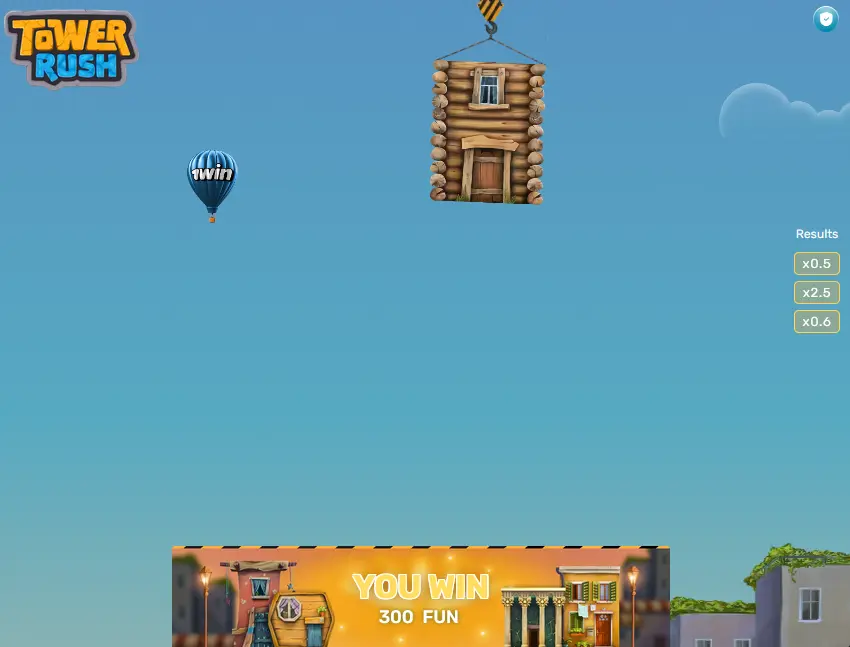
Cashout in Tower Rush
How a Round Works
A round in Tower Rush follows a simple loop, but each step carries a decision:
- Set your stake using the bet field. The ×2 button doubles your previous bet instantly, and an All In option stakes your full balance — use it carefully.
- Press the yellow Build button to drop the first floor segment.
- Watch it land. A successful placement reveals the multiplier assigned to that floor, which combines with your existing multiplier by multiplying together rather than adding — each new floor’s multiplier is applied on top of the running total, the way compounding works, not the way a running tally of separate bonuses would. Your current potential payout is shown in real time.
- Make your decision:
- Cashout — collect your current winnings and end the round.
- Build — drop the next floor and continue climbing.
- If a floor misses the tower, the round ends and your stake is lost — including any accumulated multiplier from earlier floors.
There is no time pressure between floor drops — you can take as long as you need to decide. The game only moves when you press Build. This distinguishes Tower Rush from purely automated crash games where the multiplier climbs without your input.
One detail worth knowing before your first round: not every floor multiplier is above 1x. A “successful” floor placement means the tower didn’t collapse — it doesn’t guarantee your accumulated total went up. Some floors carry a multiplier below 1x, which means a clean drop can actually reduce your running total even though nothing collapsed. This is easy to miss if you assume every successful Build press is a win in isolation. It isn’t — the meaningful number is your cumulative multiplier after each floor, not whether that specific floor “landed,” and a string of clean drops with a few sub-1x floors mixed in can leave you below where you started despite technically winning every individual placement. This variance is exactly what the game’s 96–97% RTP is built on, and it’s worth internalizing before your first session rather than discovering it mid-round.
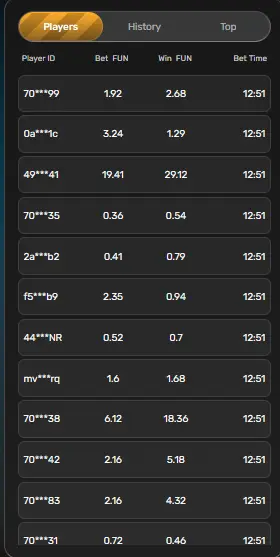
Tower Rush Winners List
What Makes Tower Rush Distinctive
Three randomly triggered bonus mechanics separate Tower Rush from standard crash games. They can appear during any floor drop and substantially change the dynamic of a round.
Frozen Floor
A floor that looks like any other reveals itself as a Frozen Floor once it lands successfully. It immediately locks your current accumulated winnings — that amount is guaranteed regardless of what happens next. You can keep building above the frozen amount with zero risk to what is already secured. The Frozen Floor triggers at most once per round and prevents further bonus mechanics from appearing after it activates.
This mechanic has a meaningful practical effect: it removes the all-or-nothing risk structure that defines most crash games. A round with a Frozen Floor lets you play aggressively on the upper floors without the usual downside — and given the sub-1x floor variance described above, a Frozen Floor is also the one moment in a round where a following sub-1x floor genuinely can’t hurt you, since your winnings up to that point are already locked in.
Temple Floor — Bonus Wheel
Landing this floor activates a 10-section prize wheel automatically. The wheel contains multiplier values of ×1.50, ×2, ×3, ×5, and ×7 (two sections each), plus one Frozen Floor Bonus section. The awarded multiplier applies to your current winnings and stacks — multiplicatively, following the same compounding logic as standard floors — with the standard floor multiplier. This feature can trigger multiple times in a single round.
Triple Build
Disguised as a standard floor until it lands, the Triple Build delivers three floors at once. Each of the three carries its own multiplier of ×1 or higher — meaning, unlike standard floors, none of the three floors inside a Triple Build activation can be sub-1x. This can trigger multiple times per round and accelerates tower height and multiplier accumulation significantly without adding placement risk — all three floors land as part of a single drop.
These three features mean that Tower Rush rounds are not uniform. A round with a Frozen Floor followed by a Triple Build plays very differently from a plain round, and this variance keeps the game from feeling repetitive over sessions.
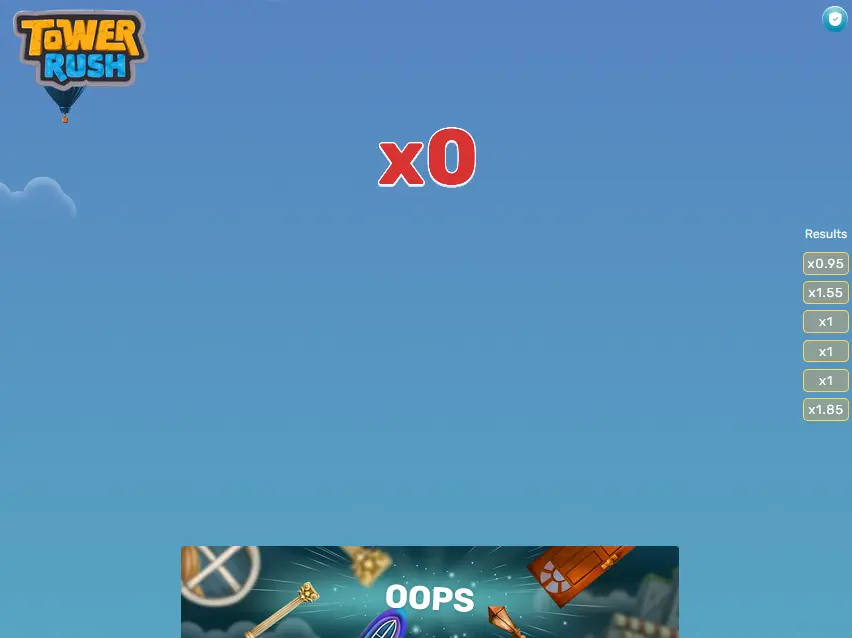
Tower Rush Game Over
How Tower Rush Differs from TOWERS
Both games involve climbing a vertical structure and deciding when to cash out. The differences are structural and affect how you actually play them.
| Aspect | Tower Rush | TOWERS |
|---|---|---|
| Provider | Galaxsys — may appear on other platforms | 1Win Games — exclusive in-house title |
| Core mechanic | No grid; floors drop automatically, land or miss | Grid format — you pick a cell per row, avoiding a hidden mine |
| Risk configuration | Fixed by the algorithm; risk managed only through exit timing | Explicitly configurable — choose 1, 3, 5, or 7 mines before the round |
| Bonus system | Three distinct random bonuses (Frozen Floor, Temple Floor, Triple Build) | None — purely cell selection and exit timing |
| Multiplier ceiling | Capped at 100× stake | No stated hard cap; can run higher across 9 cleared levels on high difficulty |
| Pacing | Kinetic, arcade-like animation between drops | Deliberate, calculation-focused between cell picks |
For players specifically chasing extreme multipliers or wanting an exact, calculable probability at every step (the way Mines offers), TOWERS’ configurable risk levels give more control.
Tower Rush trades that configurability for bonus-driven variety — its randomness lives in the bonus floors and the sub-1x mechanic rather than in a pre-round setting you choose.
Who This Game Is For
Tower Rush suits players who want a crash-format game with more mechanical variety than a standard single-multiplier curve. The bonus mechanics — especially the Frozen Floor — introduce situations that break the usual binary of “cash out or lose everything,” which makes rounds feel less uniform and more engaging over longer sessions.
Players who specifically enjoy grid-based decision-making and configurable risk levels are better served by TOWERS. If you want to pick cells and control your exact probability per step, Tower Rush does not offer that — and if you specifically want every “successful” step to guarantee upward progress, it’s worth knowing in advance that Tower Rush’s sub-1x floors mean that’s not quite how it works here.
The low minimum bet of $0.01 makes Tower Rush accessible for extended low-stakes sessions. The 100× cap keeps expectations grounded — if you are looking for a game where a single round can multiply your stake by 1,000× or more, Tower Rush is not built for that.
The game does not have autoplay. Every round requires a manual Build press to begin, which means it demands active attention throughout. Players who prefer to set parameters and run automated sessions will find this limiting.
Other 1Win Slots
 Oliver Bridgewater

