


CRASH at 1Win
CRASH is one of the simplest games in the 1Win casino — a rising multiplier, a single decision, and a fixed stake. Most descriptions of it stop at that mechanic. This guide goes further: the exact relationship between the multiplier you’re chasing and your real odds of getting there, why cash-out timing changes your risk profile but never your long-run expected loss, how the provably fair system actually lets you check a round rather than just trust it, and — using measurable, verifiable criteria rather than vague impressions — what genuinely separates CRASH from Aviator, JetX and Lucky Jet.
What Is CRASH
CRASH is a rising-multiplier game: a round starts at 1.00x, the multiplier climbs continuously, and at some unpredictable point it “crashes” back to zero. Your job is to cash out before that happens. If you cash out first, you collect your stake multiplied by whatever the multiplier read at that moment. If the crash comes before you cash out, you lose your stake in full.
There’s no house-controlled decision happening mid-round — the crash point for each round is generated before betting closes, using a provably fair cryptographic method, and simply revealed to players as the multiplier climbs toward it.

Crash Game Loading
How a Round Works
- A new round opens; players place stakes during the betting window.
- The multiplier begins climbing from 1.00x once betting closes.
- You can cash out manually at any point, locking in your stake × the current multiplier.
- At an unpredictable point, the round crashes — anyone still in loses their stake.
- A new round begins immediately after.
Stakes range from $0.25 to $300 per bet, and a single win is capped at a maximum payout of $10,000. You can also place two separate stakes in the same round, each with its own cash-out target — a way to run one conservative exit and one higher-risk exit simultaneously, which is covered in more detail below.
The Math You Actually Need: What a Multiplier Target Really Costs
This is the part almost no CRASH guide states plainly, and it’s the single most useful thing to understand before choosing a cash-out target. Every crash game of this type — regardless of provider — follows the same underlying relationship: the probability of the multiplier reaching any given target is approximately equal to the game’s RTP divided by that target multiplier.
1Win has not published an official RTP for CRASH, but crash games of this type commonly run in the 96–97% RTP range industry-wide — treat this as a general benchmark rather than a confirmed number for this specific title, and don’t assume it matches Aviator’s or Lucky Jet’s published figures exactly, since visually identical crash games can run different underlying RTP settings even when the interface looks the same.
What the formula does let you see, using a representative 97% reference point common across the genre, is the shape of the trade-off:
| Cash-out target | Approximate chance of reaching it | Expected value per $1 staked |
|---|---|---|
| 1.5x | 64.7% | −$0.03 |
| 2x | 48.5% | −$0.03 |
| 3x | 32.3% | −$0.03 |
| 5x | 19.4% | −$0.03 |
| 10x | 9.7% | −$0.03 |
| 20x | 4.9% | −$0.03 |
| 50x | 1.9% | −$0.03 |
The number that doesn’t change down the column is the point. No cash-out target has a mathematical advantage over another. A 1.5x target wins far more often, but each win is small; a 20x target wins rarely, but each win is large — and at a fixed house edge, those two facts cancel out exactly. Choosing a lower or higher target changes your variance — how smooth or how streaky your sessions feel — but it does not change your long-run expected loss per dollar wagered. Anyone framing a specific multiplier as the “smart” or “safe” target is describing a preference, not an edge.
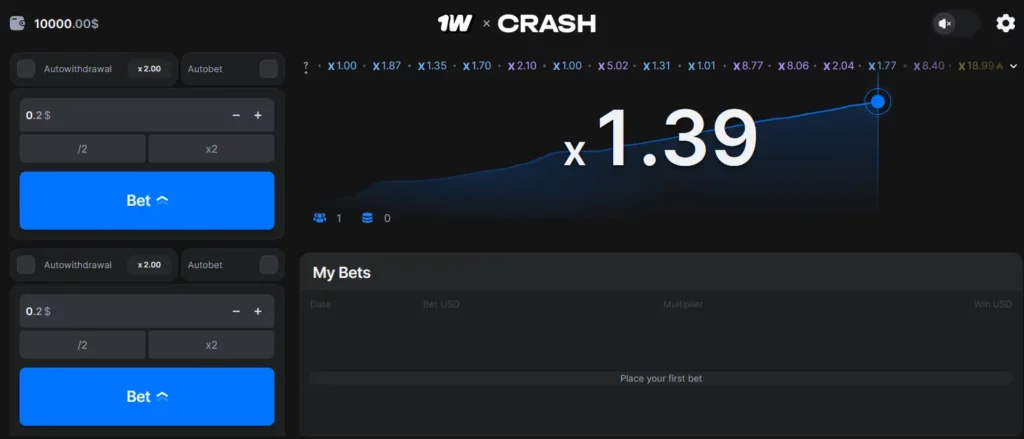
1Win Crash Gameplay
When You Win and When You Lose
A conservative exit: you stake $20 and set a mental target of 1.8x. The multiplier passes 1.8x and you cash out manually, collecting $36 — a $16 profit.
A late exit attempt: you stake $50 aiming for 5x. The multiplier climbs past 2x, 3x, and you decide to hold out — but it crashes at 3.8x, before you click cash out. You lose the full $50.
The second example is worth generalizing rather than treating as one unlucky round: the multiplier has no memory of how far it’s already climbed. A round that’s already passed 3x isn’t “due” to crash any sooner or later than one that just started — the crash point was set before the round began, and every additional second you stay in carries the same underlying risk the formula above describes, not a rising or falling one based on how long the round has already run. Watching a live multiplier climb creates a strong intuitive pull to wait “just a little longer,” but that pull isn’t backed by anything in the math — it’s a psychological effect, not a signal.
How Auto-Withdrawal Works
Auto cash-out lets you set a target multiplier in advance, so the system exits your position automatically the instant that multiplier is reached — removing the split-second decision and the temptation to hold past your original plan. Auto-bet lets you repeat the same stake automatically for a set number of rounds without re-entering it each time.
Combining the two — a fixed stake, a fixed auto cash-out target, run automatically over a set number of rounds — is the closest thing to a repeatable, disciplined approach this game allows. It’s worth being clear about what it does and doesn’t do: it enforces consistency and removes emotional decision-making mid-round, but per the table above, it doesn’t change the expected value of any individual round. Using two simultaneous stakes with different auto cash-out targets — for instance a conservative 1.5x on one and a higher 5x on the other — lets you split a single round into two different risk profiles at once, which is a genuine tactical option, though it’s a way of shaping variance, not of beating the underlying math.
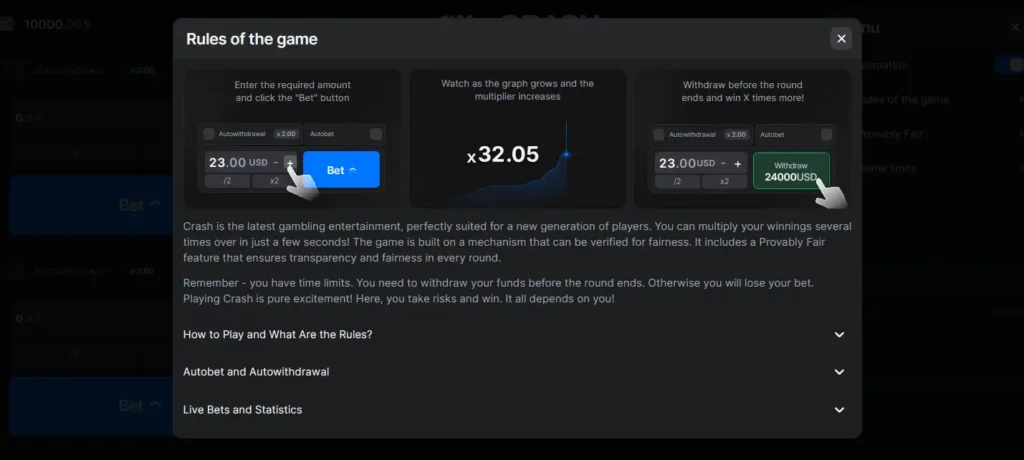
Rules of the game Crash at 1Win
Provably Fair: What’s Actually Being Verified
CRASH uses a provably fair system, which means the crash point for each round is generated and cryptographically committed to before betting closes — not decided afterward based on how much was staked. In the standard implementation used across this genre, the site publishes a hashed “server seed” before the round; that hash is combined with one or more “client seeds” and a round counter (a nonce) to deterministically produce the crash point. After the round ends, the original server seed is revealed, so anyone can recompute the hash themselves and confirm it matches what was published beforehand — proving the result wasn’t altered once betting had already closed.
This doesn’t mean the outcome is fair in the sense of favoring you — the house edge described above is still built into the formula regardless of whether you verify a round. What provably fair confirms is narrower and still meaningful: that the operator couldn’t see your stake and adjust the crash point in response to it.

Crash at 1Win
How CRASH Actually Differs from Lucky Jet, JetX and Aviator
Visually, these games look close to interchangeable — a rising multiplier, a crash point, a cash-out button. The differences that actually matter are structural, not cosmetic, and worth checking directly rather than assuming:
- The provably fair scheme itself varies by developer. Aviator (Spribe) combines seeds from multiple players who bet first in a round; JetX (SmartSoft) typically uses a single client seed; in-house “1win Gaming” titles are commonly built around a four-seed combination. This affects exactly what you’d check if you verified a round yourself, though it doesn’t change the basic guarantee described above.
- Published house edges differ by developer, not by re-skin. Where a house edge is disclosed at all, Aviator commonly runs close to 3%, JetX closer to 4% — a real difference in long-run cost per dollar wagered, if accurate for the specific configuration in use. 1Win doesn’t disclose CRASH’s own figure, so this is a reason to check the in-game info panel rather than assume any specific number carries over.
- Round pacing differs, which changes how many rounds you play per hour and therefore how quickly variance accumulates, even at an identical house edge.
What doesn’t meaningfully differ between them: the underlying mathematical relationship between your cash-out target and your odds, which follows the same shape in every legitimate implementation of this game type regardless of branding.
Who This Game Is For
CRASH rewards players who set an exit target before the round starts rather than reacting to the rising curve in real time — the auto cash-out feature exists specifically because in-the-moment decisions during a rising multiplier are where most players lose more than they planned to risk.
Auto cash-out and auto-bet are worth using specifically to remove the “just a little longer” impulse described above, since that impulse is the main way a disciplined plan gets abandoned mid-round — not because either feature changes what you can expect to win over time.
Other 1Win Games
 Oliver Bridgewater

