


TOWERS at 1Win
TOWERS is a tower-climbing game available through 1Win, built around a single decision repeated at every level: keep climbing or lock in what you’ve won. Most write-ups of this game describe the mechanic and stop there. This guide goes further — it separates what’s actually confirmed about TOWERS from what reviewers commonly guess at, and builds a decision framework around the numbers that genuinely exist.
What TOWERS Actually Is
TOWERS is a 9-level tower-climbing game developed by 1Win Games, first available on the platform since 2023. On each level, you’re shown a row of cells and must select one. Most cells are safe; a set number hide a virus. Pick a virus and the round ends immediately with your stake lost. Pick safely and you advance, with your multiplier increasing for that level.
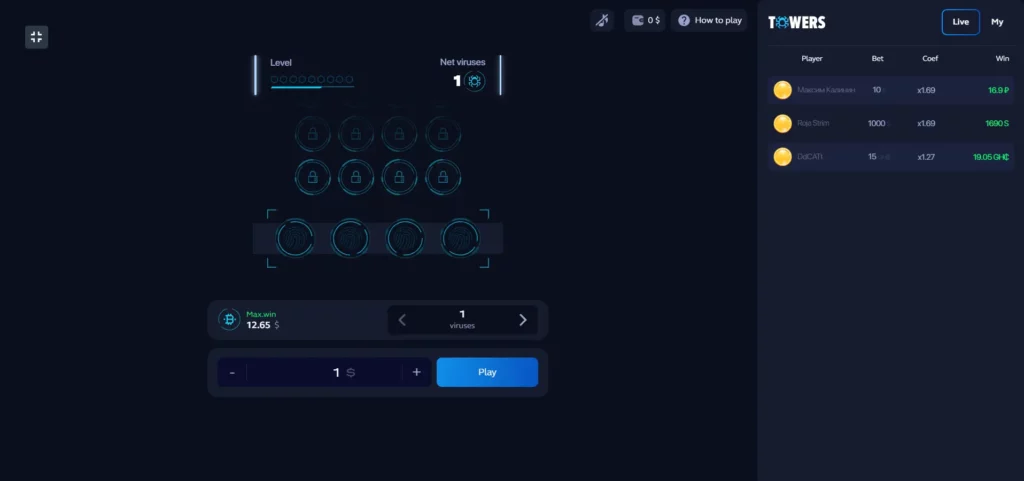
Towers slot
What makes TOWERS different from a passive slot spin: you can cash out after any successful level — you don’t need to reach level 9 to collect a payout. That single choice, repeated up to nine times per round, is the entire game.
Key specs at a glance:
| Feature | Detail |
|---|---|
| Provider | 1Win Games |
| Levels | 9 |
| Betting range | $0.10 – $200 |
| Difficulty modes | Easy, Medium, Hard |
| Demo mode | Available |
| Fairness verification | Provably Fair (hash-based, checkable in betting history) |
A demo mode is available if you want to test how the interface and difficulty settings feel before wagering real money. Every result is also stored in your betting history with a hash you can independently verify — the same Provably Fair approach used across most 1Win originals, so you’re not asked to take the outcome on faith.
How the Difficulty Settings Change the Odds
Before each round, you choose one of three difficulty levels. This choice directly sets how many virus cells appear per row:
| Difficulty | Virus cells per level | Multiplier growth | Risk per pick |
|---|---|---|---|
| Easy | 1 | Slowest | Lowest |
| Medium | 2 | Moderate | Moderate |
| Hard | 3 | Fastest | Highest |
More virus cells per row means more risk — but the number that actually determines your survival chance on a given level is the ratio of virus cells to total cells in that row, not the virus count alone. The total number of cells per row hasn’t been publicly disclosed, and it isn’t clear whether that ratio stays fixed or tightens as you climb higher. Without that figure, no reviewer can state your precise survival percentage per level — and any source that gives you one without citing where it came from is presenting a guess as fact.
What you can rely on: the in-game interface shows your live multiplier and implied odds before every pick. That figure, generated by the game itself at the moment you’re playing, is the only reliable number in the entire decision — not anything printed in a review, including this one.
RTP: What’s Confirmed and What Isn’t
Return to Player (RTP) is the percentage of all wagered money a game returns to players over the long run; the gap between 100% and the RTP is the house edge.
An official RTP for TOWERS has not been published at the time of writing. For context, 1Win’s other tower-style title, Tower Rush, carries a confirmed RTP of 96.12%–97%. If TOWERS shares a similar house-edge structure, a comparable range is a reasonable expectation — but that’s an inference from a sibling product, not a confirmed figure for this game, and it should be treated accordingly.
It’s worth being blunt about why this matters: search around for “TOWERS RTP” and you’ll find third-party sites confidently quoting figures anywhere from 95% to 98% — but those numbers typically belong to entirely different games also called “Towers” (from providers like Turbo Games, Roobet, or Stake), not to 1Win’s TOWERS specifically. Treat any RTP figure attached to this exact game with caution unless it’s sourced directly from 1Win.
Since 1Win has not published an official RTP for TOWERS, treat any specific percentage you see elsewhere as unverified. What you can verify directly is the payout table in-game — cross-check it against the compounding math in this article rather than trusting a third-party number.

Towers How to Play
Why the Odds Compound Faster Than Intuition Suggests
Here’s the part that matters more than any single-level percentage: your chance of clearing the entire tower falls off far faster than your chance of clearing any one level, because each level’s survival chance multiplies against all the ones before it.
Take a level with a 90% chance of surviving — comfortably safe-feeling on its own. Carried across all 9 levels without any tightening of the odds, the chance of clearing the full tower is roughly 39%. Drop that per-level chance to 75%, and the full climb falls to under 8%.
These percentages illustrate how compounding works, not TOWERS’ actual published numbers — but the mechanism they illustrate applies regardless of what the real per-level number turns out to be. The practical consequence: a difficulty setting or exit point that “feels” safe at any single level can still make full clears rare, simply because you’re repeating that risk up to nine times in a row.
Risk and Reward in Practice
| Approach | Difficulty | Typical exit point | What it trades off |
|---|---|---|---|
| Cautious | Easy | Level 4–5 | Lower multiplier, but far more rounds actually reach a payout |
| Balanced | Medium | Level 5–6 | Moderate multiplier, roughly even split between cashed-out and lost rounds |
| Aggressive | Hard | Level 7–9 | High multiplier on successful rounds, but most attempts end in a lost stake |
None of these is objectively correct — the built-in house edge applies over enough rounds regardless of which difficulty or exit point you pick. What differs is the shape of your outcomes: Easy produces frequent, modest wins; Hard produces rare, large ones with more losing rounds in between. The right fit depends on whether your bankroll is built to absorb a long run of losses while waiting for one large payout, or whether you’d rather see your stake come back more often in smaller amounts.
A Cash-Out Framework Built for TOWERS’ Structure
TOWERS’ vertical, one-way structure — you can’t skip a level or return to one you’ve cleared — makes the exit decision more consequential than in games with a flat, any-order grid. Two things follow directly from that structure:
Set your target level before the round starts, tied to the difficulty you picked. On Easy, pushing past level 5 or 6 starts trading a shrinking survival chance for a multiplier that’s still growing slowly — the risk-reward balance shifts against you faster than the payout compensates. On Hard, the same shift happens by level 3 or 4, because each pick already carries triple the virus density of Easy. The right exit point isn’t a single number — it’s relative to which difficulty you’re on.
Weigh each pick against what you’d lose, not just what you’d gain. Because TOWERS has no path back, losing at level 8 forfeits a multiplier that took eight successful picks to build — a materially different loss than busting at level 2. As you climb, the question worth asking before each pick isn’t “can I go further” but “is what I’d lose right now worth what the next level adds.”
Each round is independent. TOWERS has no memory of your last result, and a longer climb this round doesn’t carry better odds because you lost the round before. Extending a climb specifically to chase a previous loss is a bankroll-management error, not a strategy — the game’s mechanics don’t reward it.

Towers Mobile Gameplay
TOWERS vs. Mines vs. Tower Rush
| Feature | TOWERS | Mines | Tower Rush |
|---|---|---|---|
| Structure | 9 fixed vertical levels | Open flat grid, any order | Continuous floor-building, no fixed ceiling |
| Path | Strictly vertical, no skipping or backtracking | No fixed path | Vertical, no fixed ceiling |
| Cash-out points | After any cleared level | Any time during the round | Variable, with bonus floors |
| Published RTP | Not disclosed | Varies by configuration | 96.12%–97% (confirmed) |
The structural difference has a direct practical consequence: in Mines, you can clear cells in whatever order suits your read of the board, so a bad early guess doesn’t lock you out of the rest of the grid. In TOWERS, one wrong pick ends the round outright, regardless of level — there’s no partial recovery. Tower Rush follows the same vertical logic as TOWERS but removes the fixed 9-level ceiling in favor of continuous building with bonus floors, trading some of TOWERS’ discrete, transparent exit points for open-ended pacing — and it’s the only one of the three with a publicly confirmed RTP.
TOWERS suits players who want a fixed, countable number of decision points with a visible multiplier at each one. Mines suits players who prefer reading an open board rather than committing to one irreversible direction. Tower Rush sits closest to TOWERS structurally, but for players who want the climb to keep going rather than cap at level 9.
Where TOWERS Fits and Where It Doesn’t
TOWERS suits players who want to control their own risk curve rather than accept a fixed one. Because each level’s odds compound the same way regardless of how many levels you’ve already cleared, the game rewards a pre-set exit plan more than in-the-moment judgment calls — deciding at level 4 or level 6 before you start, not reacting to how the run “feels” after a few safe picks.
Easy mode is the more forgiving entry point precisely because the one-way structure is unforgiving in every mode — with only one virus cell per row, a single mistimed pick is less likely, which matters more here than in Mines, where a bad pick doesn’t necessarily end the board. Hard mode should be reserved for players who’ve already internalized how fast the full-tower odds fall off across nine compounding levels, not just how risky any single pick feels in isolation.
Before your first real-money round, it’s worth trying the demo mode to get a feel for how the multiplier grows on each difficulty, and checking your registration and any active bonuses that might apply to your first deposit.
Other 1Win slots
 Oliver Bridgewater

