


Speed-n-Cash at 1Win
1Win brings its own original crash game identity to the table with Speed-n-Cash — a proprietary title developed by 1Win Games that takes the multiplier-climbing crash format and rebuilds it around high-speed racing cars instead of the planes and rockets that dominate the category. Two supercharged vehicles — one blue, one orange — run independent races simultaneously on a split-screen display, and players can bet on either car individually, on both at once, or place a head-to-head wager picking which car will finish with the higher coefficient. With bets starting from $0.10, a maximum single-car wager of $420, and the full range of autobet and auto-withdrawal automation, Speed-n-Cash delivers a genuinely differentiated crash experience that goes beyond cosmetic theming into structural gameplay variety.
What Is This Game
Speed-n-Cash is a proprietary 1Win Games title available only on the 1Win platform. Two cars — one blue, one orange — race simultaneously. Each car has its own multiplier that rises independently. You place bets on either car individually, on both at once, or on which car will finish with the higher coefficient. You cash out before the car drives off screen, or you lose the stake.
| Feature | Details |
|---|---|
| Developer | 1Win Games |
| Game Type | Crash Game — Dual Car Racing |
| Minimum Bet | $0.10 per car or H2H |
| Maximum Single-Car Bet | $420.00 |
| Head-to-Head Payout | 1.89x (as shown in-game) |
| Autobet | Yes |
| Auto Withdrawal | Yes |
| Round History | Last 40 rounds displayed |
| Global Bets View | Yes — all active player bets |
| In-Game Chat | Yes |
| Demo Mode | Yes |
| Provably Fair | Yes |
| Mobile Ready | Yes — browser-based |
Speed-n-Cash Loading 1Win
A note on RTP and the win cap. No official RTP has been published for Speed-n-Cash at the time of writing. Search for it and you’ll find third-party figures scattered anywhere from roughly 94% to over 98%, often attached to guides that also disagree with each other on the maximum bet, the maximum multiplier, and even the release year — a spread wide enough that no single number among them can be treated as confirmed. Treat any RTP you see attached to this specific game with the same caution you’d apply to an unconfirmed figure on any other 1Win original. The $30,000 absolute win cap and the fixed 1.89x H2H payout referenced in this guide reflect what’s shown in the current game interface rather than a figure independently published and confirmed elsewhere — check the in-game rules panel for the live numbers before you rely on them for stake planning.
That said, one specification is worth understanding regardless of the exact cap value: unlike most crash games that set a maximum multiplier as the ceiling, Speed-n-Cash appears to cap the absolute payout rather than the coefficient. Using the interface’s stated $30,000 figure purely to illustrate how that works: a $420 bet — the maximum single-car stake — would hit that cap at a multiplier of roughly 71x ($30,000 ÷ $420). A $10 bet wouldn’t reach it until around 3,000x, a multiplier that for practical purposes never occurs in a crash game’s outcome distribution. The consequence is that the payout cap functions as a real, binding constraint on strategy at high stakes — a large auto-withdrawal target can silently get capped below what the displayed multiplier suggests — and as effectively no constraint at all at low stakes, where the cap would only matter at multipliers no round realistically reaches. Whatever the live cap figure turns out to be, this relationship between stake size and where the ceiling actually bites is the thing to factor into stake selection and auto-withdrawal targets, more so than in a single-multiplier-cap game where the ceiling is the same number regardless of bet size.
How Bets Work
Each round opens a five-second betting window after the previous race ends. During this window you can activate any combination of the three available positions:
- Blue car — a standard crash bet on the left car. Pays stake × coefficient at the moment you cash out. If the car exits before you withdraw, the bet is lost.
- Orange car — identical mechanics on the right car. Runs fully independently of the blue car. One car can reach 15× while the other crashes at 1.2× — the outcomes have no connection to each other.
- Head-to-head (H2H) — a fixed-odds wager on which car finishes with the higher coefficient. No cash-out decision is needed. The bet resolves automatically at the displayed fixed payout if your chosen car wins the comparison, and zero if it does not.
You can place all three in the same round simultaneously. Stakes are set independently per position — your blue car bet and orange car bet do not need to match.
Auto withdrawal lets you set a target multiplier per position in advance. The system closes the bet automatically when that coefficient is reached, removing the timing pressure of manual cash-out. Combined with Autobet, you can run a fully automated session with a fixed stake and fixed exit target across every round — though as the win-cap math above shows, a high auto-withdrawal target paired with a large stake can resolve at the payout cap rather than at the multiplier you actually set, so the two settings need to be checked against each other, not chosen independently.
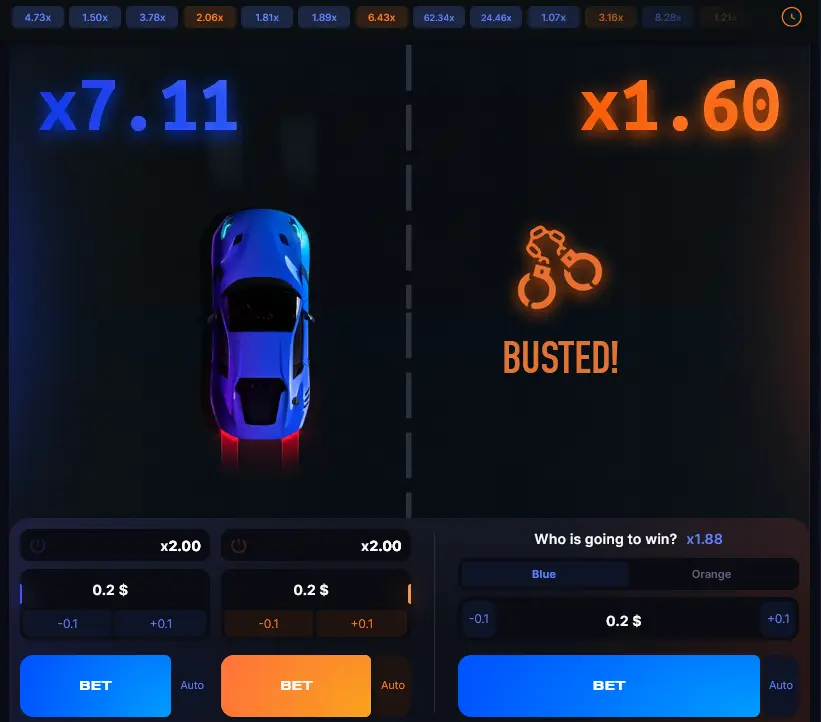
Speed-n-Cash Game Field
What Modes Are Available and What They Actually Cost You
Single car betting is the standard crash format. You monitor one multiplier and decide when to exit. The main addition compared to a standard crash game is that you can do this for both cars simultaneously within the same round — two independent crash bets at once.
This creates a hedging structure that doesn’t exist in single-vehicle crash games. Take a concrete version of it: stake $20 on the blue car with auto-withdrawal set at 1.5×, and stake $20 on the orange car with no auto-withdrawal, watching it manually for a higher target. If blue survives to 1.5× (which, all else equal, is a more frequent outcome than a large manual target further out), it closes automatically for $30 — a $10 profit on that leg regardless of what orange does. If orange then crashes before your manual target, the round nets a $10 loss overall ($30 back on $40 staked) instead of a full $40 loss.
The hedge doesn’t change the underlying house edge on either bet; it changes the shape of your outcomes, turning some rounds that would otherwise be total losses into smaller, partial ones.
Head-to-head betting is a different engagement mode entirely. There’s no multiplier to monitor, no timing decision, no cash-out button. You pick a car, the race runs, and the bet resolves on its own. At the 1.89x payout shown in the current interface, and assuming the comparison is close to a genuine 50/50, the implied house edge works out to roughly 5.5%: 1 − (1.89 × 0.5) = 0.055. That’s noticeably steeper than the 2–3% range typically associated with single-car crash betting at moderate cash-out targets elsewhere in this category — though, as with RTP, no independently confirmed single-car figure exists for this specific game either, so treat that comparison as directional rather than exact. The structural point holds regardless of the precise gap: H2H trades away the timing control that gives single-car betting its flexibility, in exchange for a bet that resolves itself at a mathematically less favorable rate. It works as an occasional format variation — a hands-off round between manually played ones — but isn’t a strong primary session strategy.

Speed n Cash game
How Speed-n-Cash Differs from Other Crash Games
Most single-multiplier crash games — Aviator and Lucky Jet among 1Win’s own catalog are the clearest points of comparison here — are built around one core mechanic: one multiplier, one bet, one cash-out decision per round. The visual theme changes but the mechanic doesn’t. Speed-n-Cash changes the mechanic itself in two ways.
Two independent crash events per round. In Aviator or Lucky Jet, one outcome determines whether your session goes up or down on that round. In Speed-n-Cash, two separate outcomes occur simultaneously. A round where blue crashes at 1.1× and orange reaches 7× produces a split result that no single-vehicle game can generate. This means session variance plays out differently — you’re not in an all-win or all-lose position on most rounds, which is precisely what makes the hedging structure above possible in the first place.
Head-to-head betting. No other crash game on 1Win offers a fixed-odds wager on a comparative outcome between two simultaneous events. It’s a structurally different bet type, not a variation on the multiplier-timing format — and, as shown above, a mathematically different proposition too.
Compared to Lucky Jet specifically: both are 1Win Games originals exclusive to the platform. Lucky Jet is a standard single-multiplier crash game with one cash-out decision per round. Speed-n-Cash is the more complex title: dual-race mechanics, three simultaneous position types, and a payout cap that interacts with stake size in a way Lucky Jet’s structure doesn’t have to account for. Players familiar with Lucky Jet can treat Speed-n-Cash as the next step up in the 1Win Games catalog, not a reskin of the same decision.
Compared to Aviator: Aviator has one plane, one multiplier, and optionally two simultaneous bets on that same single event. Speed-n-Cash has two cars with two fully independent multipliers plus a third H2H bet type layered on top. The independence is the key difference — in Aviator, both of your bets rise and crash together; in Speed-n-Cash, they don’t, and that’s the entire basis for hedging one against the other.
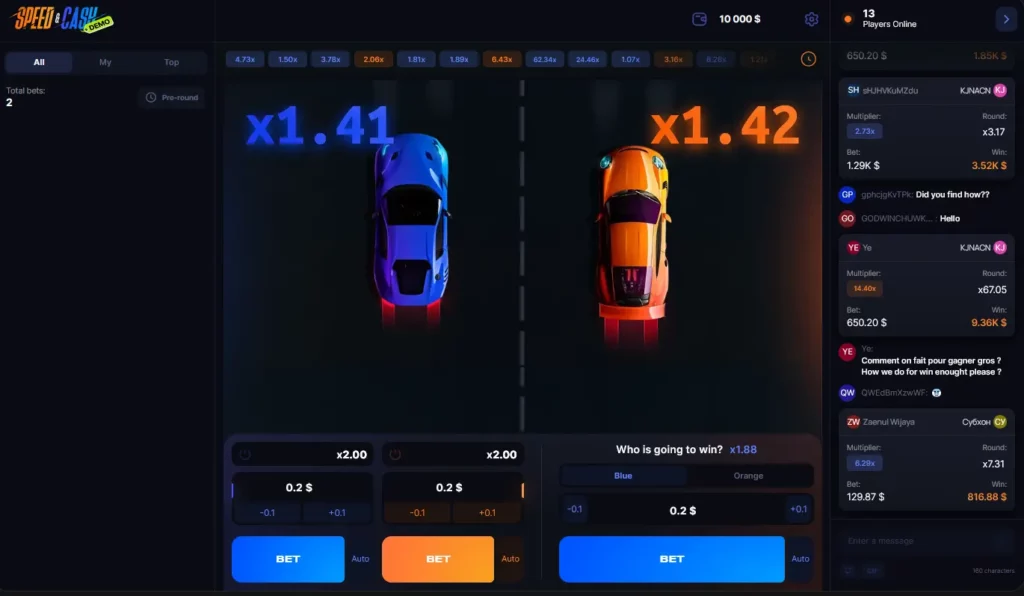
Speed-n-Cash Interface
Who This Game Is For
Speed-n-Cash suits players who are already comfortable with standard crash mechanics and specifically want the hedging structure that two independent outcomes make possible — setting one position to auto-withdraw conservatively while running the other for a bigger target is the one thing this game offers that Aviator or Lucky Jet structurally cannot. If that trade-off doesn’t interest you, the extra complexity buys you little over a simpler single-multiplier game.
H2H suits a narrower, different use case: a genuinely hands-off round between manually played ones, chosen specifically because you don’t want to watch a multiplier that round — not because the bet is mathematically favorable, since the math above shows it isn’t. Treat it as a pacing choice, not an edge play.
The game fits players who want to actively manage a stake-dependent payout cap as part of their strategy — that’s a real, non-trivial decision layer, not a footnote — while it fits poorly for anyone who wants a session with a single number to watch and a single moment to decide. For that simplicity, Aviator or Lucky Jet remain the more direct choice. The $0.10 minimum keeps low-stakes exploration accessible, and demo mode lets you test the hedging math above without risking anything while you get a feel for how the two cars actually diverge round to round. Once you’re ready to move to real-money play, you’ll need a registered 1Win account — it’s worth checking the bonuses section beforehand, since a first-deposit offer can extend your starting bankroll for testing the strategies described above. Speed-n-Cash sits alongside the rest of the 1Win casino lineup, including Lucky Jet and Aviator, if you want to compare the formats side by side.
Other 1Win Games
 Oliver Bridgewater

