


DOUBLE at 1Win
Double is a fast, color-prediction game built by 1Win Games — pick red, blue, or green before a round resolves, and if the outcome matches your color, your bet returns at that color’s multiplier. It’s one of the simplest games in the 1Win lineup, but the simplicity hides the one question every round actually turns on: why does one color pay roughly seven times more than the other two? This guide answers that directly, is upfront about what 1Win hasn’t published, and gives a framework for reasoning about the risk instead of just repeating the rules. You can test everything below in demo mode at 1Win before betting real money.
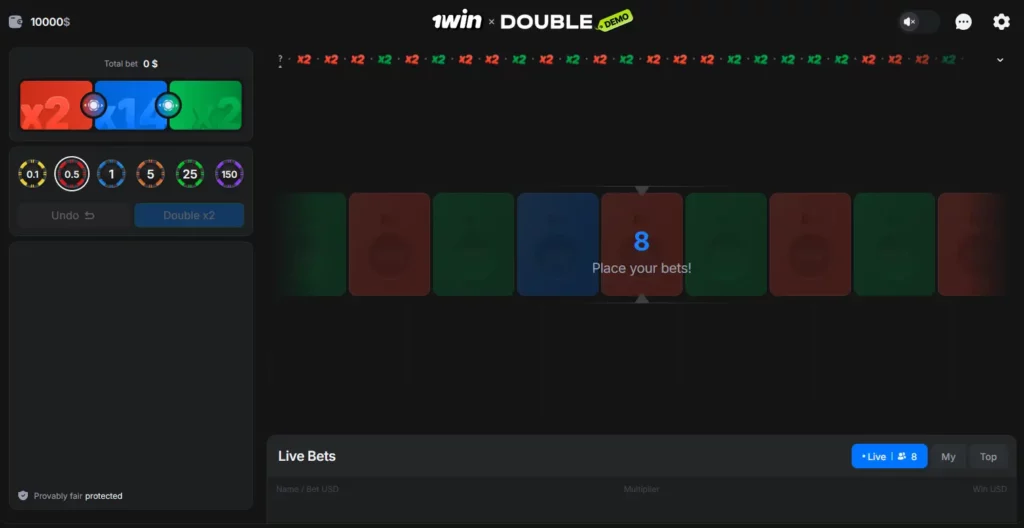
How the Game Works
Each round follows the same short cycle:
- A betting window opens, during which you choose one or more chip values and place them on red, blue, and/or green sectors.
- The round resolves to a single outcome — one of the three colors.
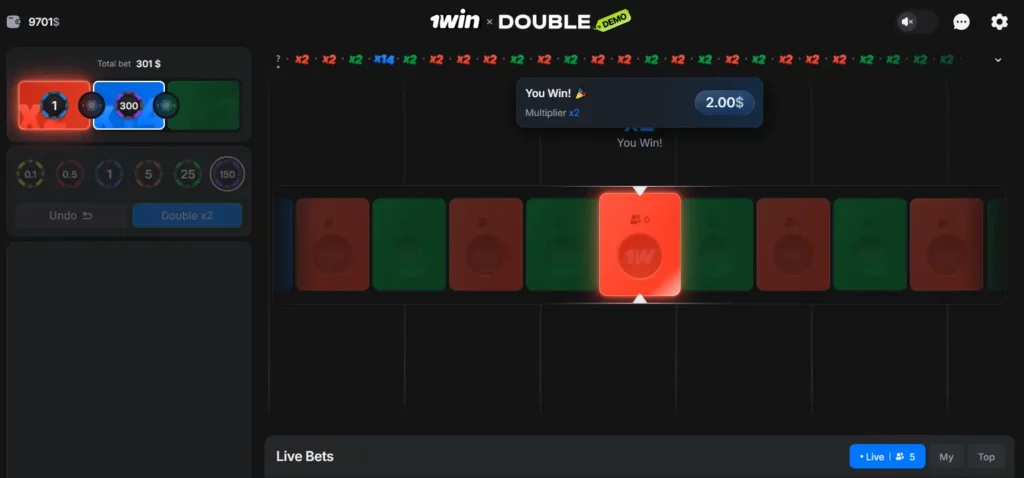
- If your chosen color matches the outcome, your bet is multiplied by that color’s payout: 2x for red or blue, up to 14x for green.
- If it doesn’t match, the stake on that sector is lost, and the next betting window opens immediately.
Double at 1Win
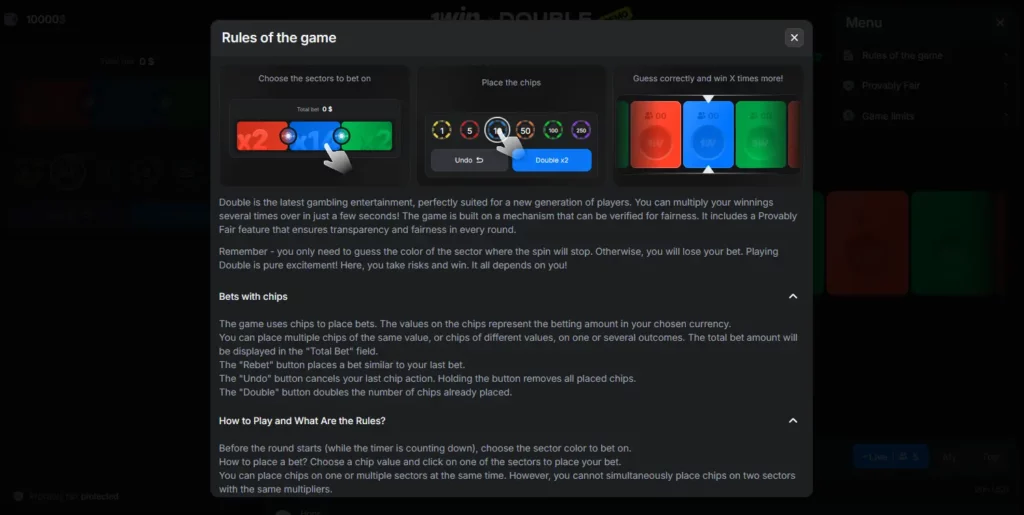
Bets are placed using fixed chip denominations — 1, 5, 10, 50, 100, and 250, in your account’s currency — and you can stack multiple chips of the same or different values onto one or several sectors in the same round. A “Rebet” button repeats your last total bet, “Undo” removes chip actions one at a time (holding it clears everything), and “Double” doubles the chips already placed. One rule worth knowing before you start stacking bets: you cannot place chips on two sectors that carry the same multiplier at the same time — since red and blue both pay 2x, betting both simultaneously isn’t possible; you can only combine a 2x sector with the 14x sector, or bet a single color alone.
Per the game’s own limits screen, bets range from $0.1 to $1,000,000 per round, with a separate maximum payout cap of $50,000,000 on any single round regardless of stake — worth knowing if you’re ever betting at the high end, since the payout cap, not the bet limit, becomes the binding constraint at very large stakes on the 14x sector. The game is available in 1Win’s casino in demo mode, so the mechanics below can be tested without registration first.
Why the Multipliers Are So Different — and What That Actually Means
This is the part most guides to this game skip entirely, and it’s the only thing worth understanding before playing.
Exactly one of the three colors wins on every round — there’s no scenario where two colors both resolve, and no scenario where none of them do. That means the three win probabilities for red, blue, and green must add up to 100% between them. The fact that green pays 14x while red and blue each pay only 2x is a direct signal about relative frequency: green has to be a meaningfully rarer outcome than red or blue, or the payout structure wouldn’t function as a casino game at all. If green came up anywhere close to as often as red or blue, paying it out at 14x would hand players a long-term profit — which no operator builds into a game by design.
A rough way to think about it: if a color’s payout were priced at exactly the “fair” value for its probability (no house edge at all), red and blue at 2x would each need to win 50% of the time — but that’s already 100% between just those two, leaving nothing for green ever to occur. Since green clearly does occur, the real split has to look different: red and blue each take up somewhat less than 50% of outcomes, and green takes up a small remaining share — with the house edge built in by pricing every color’s payout slightly below its true breakeven probability, which is standard practice across this type of game.
What isn’t knowable from the outside: 1Win doesn’t publish the exact probability split behind Double, and no independent testing lab has certified specific numbers for it — the same situation as several other 1Win Games instant titles, including Mines. Based purely on the size of the payout gap, a reasonable working estimate is that green lands somewhere in the single-digit percentage range per round, with red and blue splitting most of the remainder close to evenly — but treat that as an estimate grounded in the math of how these payout structures are typically built, not a confirmed statistic. If a specific RTP or probability figure for Double is quoted to you elsewhere, apply the same skepticism you would to any unsourced number.
Double at 1Win Rules
Provably Fair: What It Verifies, and What It Doesn’t
Double includes a Provably Fair system, and it’s worth being precise about exactly what this does and doesn’t tell you, since it’s easy to mistake it for the transparency the section above says is missing.
Per the game’s own explanation: the result of each round depends on which sector is selected, and each sector is assigned a numerical value. That value is generated on 1Win’s servers when the round begins and is publicly displayed in encrypted form as a Hash. At the end of the round, the same Hash is saved in the round history alongside a Salt value, and you can check the pairing yourself — either through the “Fairness Check” window in the game or with any independent online hash calculator — to confirm the outcome wasn’t altered after the fact.
This is a real and meaningful guarantee, but it answers a narrower question than “what are my odds.” Provably Fair confirms that a given round’s result was fixed in advance and not tampered with retroactively — it doesn’t reveal how sectors are weighted, how often each color is assigned as the winning value, or what the underlying probability distribution actually is. In other words: you can verify that any single round you played wasn’t rigged after the fact, but that’s a different claim from knowing the long-run frequency of green versus red and blue — the second thing remains unpublished. Both statements are true at once, and it’s worth not conflating them.
What This Means for Risk in Practice
Because green is the rarer outcome by design, betting green isn’t just “higher risk, higher reward” in a vague sense — it means accepting a long run of losses is the expected texture of that bet, punctuated by an occasional 14x return, rather than a steadier stream of smaller wins. Betting red or blue trades away the size of the occasional win for an outcome that resolves in your favor closer to half the time.
Neither choice has a built-in edge in your favor — the payout structure exists specifically so that, over a large number of rounds, all three bets return less than was staked on them, with the house’s margin coming from exactly the kind of underpricing described above. No sequence of past rounds changes this: each round is generated independently, so a run of red outcomes doesn’t make blue or green more “due” on the next round.
Win at Double
Bankroll and Session Approach
Given the mechanics above, a few practical adjustments matter more here than a generic “play responsibly” note:
- If betting red or blue repeatedly, size each bet small relative to your session bankroll — around 1–2% per round — since even a near-50/50 outcome will still produce losing streaks longer than intuition suggests over dozens of rounds.
- If betting green, budget for extended losing stretches as the norm, not the exception. A rarer outcome by definition means more rounds without a payout between hits; treat any 14x return as covering several rounds of stakes, not as “catching up.”
- Remember you can’t hedge red and blue in the same round — since they share the same 2x multiplier, the game doesn’t let you place chips on both simultaneously. Any diversification has to happen across rounds, not within one.
- Don’t chase a color based on recent round history. The live feed of recent outcomes shown in the interface reflects what already happened — it has no bearing on the next round’s independently generated result, and Provably Fair confirms that fixed pre-determination, not any exploitable pattern.
- Treat red/blue and green as fundamentally different bets, not variations on the same strategy. Splitting a session bankroll between both isn’t diversification in a meaningful sense, since neither carries a positive edge to average against the other.
This is a description of how the game’s payout structure behaves, not financial advice — set your own limits based on what’s comfortable to lose, and use demo mode to see how the color distribution feels over a run of rounds before wagering real money.
How Double Compares to Other 1Win Instant Games
| Game | Format | Published RTP | What Determines Risk |
|---|---|---|---|
| Double | 3-outcome color prediction (red/blue/green) | Not published; Provably Fair verifies round integrity, not probability | Payout gap (2x vs. 14x) implies uneven color probability, but exact split isn't disclosed |
| Rocket Queen | Crash multiplier | Commonly cited 96%–97.2%, not independently certified | Player's own cash-out timing controls variance |
| Mines | 5×5 grid, chosen mine count | Not published, but survival odds are exactly calculable from board size and mine count | Player-chosen mine count and how many cells are opened before cashing out |
The practical difference worth noting: Mines lets a player calculate exact survival odds because the board size and mine count are both visible, fixed inputs. Double doesn’t offer that same transparency — Provably Fair confirms each round wasn’t altered after the fact, but the underlying color distribution itself isn’t something a player can verify directly, which is why any specific probability claim for this game deserves more skepticism than one for a game with fully visible mechanics.
Other 1Win Slots
 Oliver Bridgewater

