


CoinFlip at 1Win
CoinFlip at 1Win is an online mini-game built on the oldest bet there is: heads or tails. You pick a side, the coin flips, and a correct call multiplies your stake. Stay in after a win and the multiplier compounds; miss once and the round ends at zero. That’s the entire game — no grid, no climbing, no timing a rising curve. What separates a useful guide from a shallow one here isn’t the rules, which take one paragraph to explain in full, but what the numbers actually do to your odds the longer you keep flipping, and when to stop.
What Is This Game
CoinFlip is a provably fair instant game developed by 1Win Games and available in the 1Win casino section. It requires no skill or experience — the only decision at any point is which side of the coin to back before the flip.
The game runs on a random number generator, and every round is fully independent. There’s no pattern to read, no side that’s “due,” and no memory of past results carried into the next flip. What makes it worth a second look isn’t the coin itself but the multiplier chain: staying in after a correct guess stacks your potential payout, while one wrong call erases it entirely.
It sits in the same category as Mines, Crash, and Towers — fast-session instant games built around a visible risk curve rather than a slot’s fixed paytable.ine hash generator.
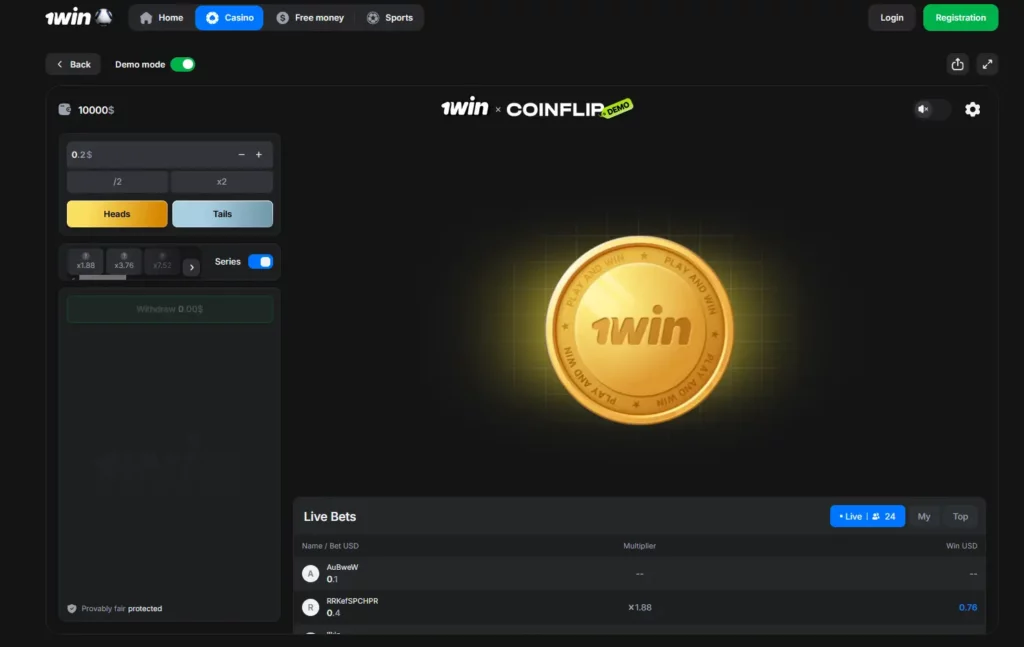
CoinFlip at 1Win
How CoinFlip Works
Each round follows the same sequence:
- You place a bet (minimum $0.10).
- You pick Heads or Tails.
- The system flips a virtual coin and reveals the result.
- If correct — you collect your winnings or continue to the next round at a higher multiplier.
- If incorrect — the entire active bet is lost, immediately, with no partial recovery.
The math behind the multiplier. Each correct prediction multiplies your current payout by ×1.95. On a true 50/50 bet, that ratio implies a house edge of roughly 2.5% per flip: 1 − (1.95 × 0.5) = 0.025. This figure comes directly from the published multiplier of this specific game — not an estimate borrowed from a different “CoinFlip” title under another provider, which matters here more than it might seem. Search the wider web for CoinFlip house edge figures and you’ll find RTPs quoted anywhere from 96% to 98%, multipliers ranging from ×1.94 to ×1.96, and even entirely different games — a pirate-themed CoinFlip from a different studio, or a live-casino “Crazy Coin Flip” — sharing the name but nothing else. None of those numbers describe 1Win Games’ CoinFlip specifically, and reporting them as if they did would be exactly the kind of unsourced borrowing this guide is trying to avoid. The only multiplier that governs your actual payout is the one shown in the game interface at the moment you play.
Example run, starting from a $10 bet:
| Round | Result | Running payout |
|---|---|---|
| Bet | — | $10.00 |
| Round 1 | Correct | $19.50 |
| Round 2 | Correct | $38.02 |
| Round 3 | Correct | $74.14 |
| Round 4 | Wrong | $0 |
The longer the chain, the larger the potential reward — and the larger the amount that gets wiped out the moment a single guess is wrong.
Provably fair verification. Every result is hashed and recorded in your betting history the moment the round settles. In practice, this means the outcome isn’t just claimed to be random — it’s generated from seed values you can check afterward: open your betting history, find the completed round, and run its hash through an independent online hash generator to confirm the recorded result matches what the game actually produced. You’re not asked to take the outcome on faith; you’re given the means to audit it yourself, after the fact, for any round you’ve played.
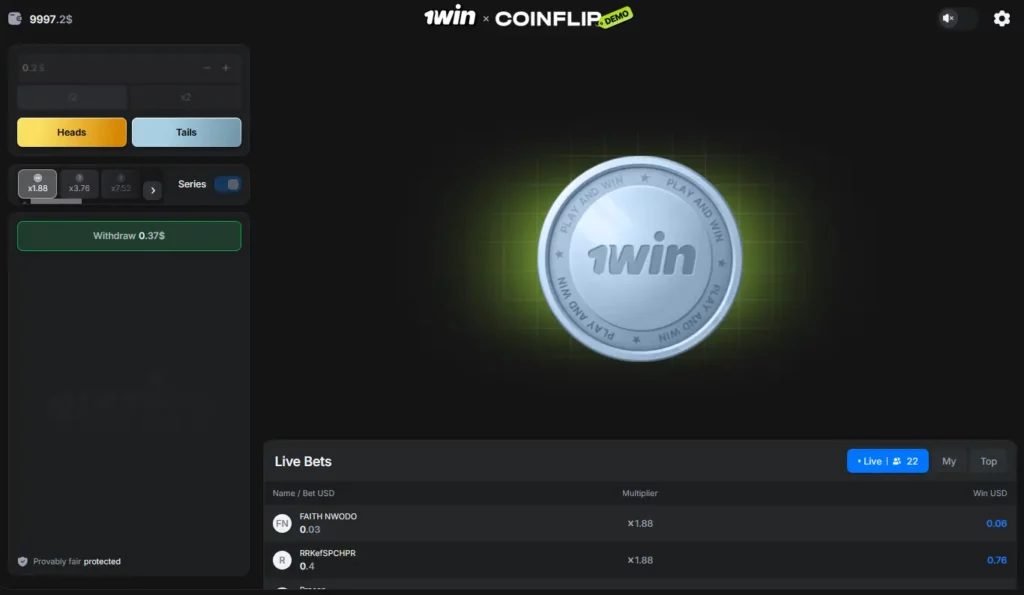
CoinFlip Win
How Fast the Odds Fall Off
Because each flip is an independent 50/50 event, the probability of stringing together several correct guesses in a row drops by half with every additional round — a geometric decline, not a linear one:
| Rounds played correctly | Multiplier | Probability of reaching this point |
|---|---|---|
| 1 | ×1.95 | ~50% |
| 2 | ×3.80 | ~25% |
| 3 | ×7.41 | ~12.5% |
| 5 | ×28.2 | ~3.1% |
| 7 | ×107 | ~0.78% |
For example, with a $10 flat bet and $500 bankroll, a run of 8 consecutive losses (roughly a 1-in-256 chance per attempt) would cost $80 — about 16% of that bankroll in a single unlucky sequence, even though each individual flip stays at fixed odds.
Three correct guesses in a row do not make the fourth flip more or less likely — the coin has no memory, and no streak, however long, changes the odds of the next call. What the table actually tells you is something else: reaching a big multiplier by staying in the chain is rare by construction, not bad luck. Anyone who continues to round 7 is, by definition, standing in the roughly 0.78% of outcomes that got there — which is worth knowing before you decide how far you plan to go.
A Cash-Out Framework Built for CoinFlip’s Structure
CoinFlip’s binary, no-partial-recovery structure means the exit decision matters more than in games where a wrong guess only costs part of your position. Three things follow directly from that:
Set your target multiplier before you flip, not after a win. Because the probability of reaching any given round is fixed and known in advance (the table above), there’s no new information generated by winning the previous round that should change your original plan. Deciding “I cash out at ×3.80” after two correct guesses is a different — and weaker — decision than deciding it before round one, because it’s made in the moment a win is already making the next flip feel safer than it is.
Weigh what you’d lose against what the next flip adds, not just the upside. At round 3, continuing risks $74.14 already built up for the chance to reach $144.57 at round 4 — a bet of your entire accumulated stake on a single 50/50 call. The higher the running payout, the more of it is on the table for the same fixed 50% chance of the next flip landing correctly. The multiplier grows every round; your odds of holding onto it do not.
Treat every round as independent, including the decision to keep playing after a loss. A loss at round 3 doesn’t make the next chain more likely to run longer, and extending a new round specifically to recover a previous one is a bankroll decision dressed up as a strategy — the coin has no memory, and the math doesn’t reward chasing.
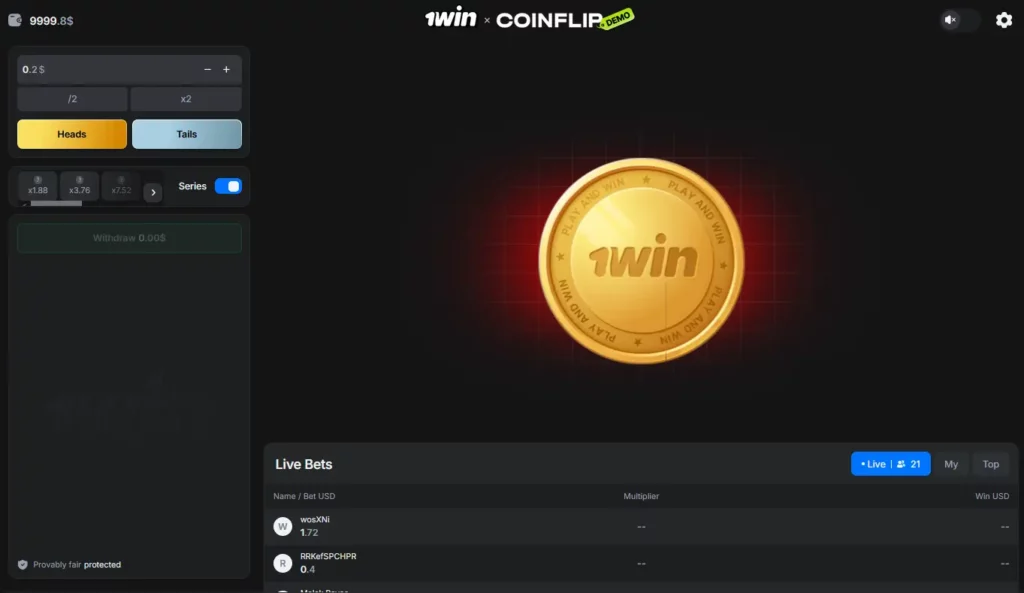
CoinFlip Interface
Who CoinFlip Suits — and Why “Just One More” Is the Real Risk
CoinFlip removes decision-making entirely once you’ve set your target — there’s no cash-out timing, no reading a rising curve, no mid-round choice. That makes it easier to calculate exactly what a losing streak will cost you before you start, which is the main practical advantage over games like Towers or CRASH, where risk builds unpredictably as the round continues.
The behavioral risk worth naming directly is what happens after a win, not after a loss. A correct guess doesn’t just add money to the running total — it also raises the visible number in a way that makes the next flip feel like a continuation of momentum rather than a fresh, unrelated 50/50 bet. That framing is the entire mechanism behind “just one more round”: the game’s design makes staying in feel like riding a streak, when mathematically each flip resets to the same odds every previous flip had. Recognizing that the pull to continue is generated by the running total on screen, not by any actual change in your odds, is the difference between playing CoinFlip with a plan and playing it on impulse.
Anyone without a pre-set loss limit, or who notices they tend to extend a session specifically after a win “to see how far it goes,” is the profile this game is least forgiving toward — not because the odds are worse for them, but because the structure offers no natural stopping point beyond the one a player sets for themselves.
Demo and Real Money Play
1Win offers both modes for CoinFlip. Demo mode runs the game on virtual credits, letting you get a feel for the multiplier progression and how quickly a chain can end before risking anything real — useful specifically for noticing how the “one more round” pull feels in practice, at zero cost. Demo results carry no cash value and can’t be withdrawn.
Real money mode requires a registered and funded 1Win account, with a minimum bet of $0.10. The maximum per round is shown directly in the game interface rather than fixed in this guide, since bet ceilings can vary by region, account status, and active promotions — a range worth checking in-app before you commit to a target multiplier from the framework above. If you’re setting up an account for the first time, it’s worth checking registration and the bonuses section for any first-deposit offer that could apply to your starting balance. The Android and iOS apps carry the same game and the same verification tools as the desktop site.
To place a bet: open CoinFlip from the game lobby, enter your stake, click Play, then pick Heads or Tails before the flip. After a win, you choose to cash out or continue; after a loss, the round ends and the stake is gone. The interface itself is minimal — a central panel with the coin, round number, and current multiplier; a top bar for sound and rules; and a side panel splitting live bets from other players against your own history and stats.
How CoinFlip Differs from Mines, Crash, and Towers
All four are instant games in 1Win’s casino section with a visible risk curve, but the similarity mostly ends at “fast session, clear risk”:
| CoinFlip | Mines | Crash | Towers | |
|---|---|---|---|---|
| Core mechanic | Binary guess (50/50) | Reveal safe cells on a grid | Multiplier rises until it crashes | Pick a safe cell per row, climb levels |
| Player control | Lowest — Heads or Tails only | Medium — choose which cells to open | Medium — decide when to cash out | Medium — choose path per level |
| Risk visibility | Hidden until the flip resolves | Partial — depends on mine count you set | Visible in real time as the multiplier climbs | Partial — depends on difficulty setting |
| Recovery after a wrong move | None — round ends instantly | Partial — one bad cell doesn't end the board | None — a crash ends the round | None — one wrong cell ends the round |
The practical difference is what kind of risk you’re actually managing. In Mines, a bad guess costs you one cell, not the board — you keep partial information and partial control after a mistake. In Crash, the risk is visible and continuous: you watch the multiplier in real time and decide when to bail, rather than committing to a binary call in advance. Towers shares CoinFlip’s all-or-nothing structure per step, but spreads it across nine visible levels with a difficulty setting that changes the odds per pick. CoinFlip strips all of that away: there’s no grid to read, no curve to watch, and no difficulty dial — just one 50/50 call, repeated for as long as you choose to keep making it. That makes it the fastest and least controllable of the four, which is either its main appeal or its main drawback depending on whether you want a session with room to adjust mid-round or one clean decision at a time.
Other 1Win Games
 Oliver Bridgewater

