


Chicken Run at 1Win: PoggiPlay’s Turn-Based Ladder Game With 5,000x Multiplier Ceiling
1Win brings a genuinely distinctive format to its crash game catalog with Chicken Run — a turn-based ladder title from PoggiPlay where a cartoon chicken hops across columns, multipliers climb with each successful step, and a hidden fail state can end the run without warning. Unlike the real-time crash games in the catalog — Rocket Queen, Speed-n-Cash, and Maestro — Chicken Run removes the time pressure entirely. The server waits for the player’s decision at each rung; nobody rushes. This deliberate, turn-by-turn cadence transforms the standard crash dynamic into something closer to a structured strategic game: advance or bank, with full awareness of the multiplier already secured and the increased risk waiting one step further. Four difficulty modes — Easy, Medium, Hard, and Hardcore — reshape both track length and payout gradient from modest incremental climbs to steep, knife-edge ladder runs that reach 5,000x at the top rung. At 95% RTP, bets from $0.11 to $110, and a jungle-swamp cartoon aesthetic that communicates every state clearly, Chicken Run rewards discipline over impulse in a format unlike anything else at 1Win.
What Makes Chicken Run Different From Standard Crash Games
The crash game category is dominated by real-time multiplier climbs — Aviator’s plane, Rocket Queen’s ascending coefficient, Speed-n-Cash’s racing cars. All of these share one fundamental characteristic: the clock is running, the multiplier is moving, and the player’s cash-out decision operates under time pressure. A delayed reaction means a lower exit point or a full loss.
Chicken Run eliminates this entirely. The ladder advances only when the player chooses to advance. After each successful column hop, the run pauses at the current rung, displaying the multiplier secured so far and offering a clean binary: bank what’s accumulated, or hop to the next column. The server does not proceed until the decision is made.
This structural difference matters more than it might initially seem. Real-time crash games engage the reflexes and create tension through the ticking multiplier. Chicken Run engages judgment and creates tension through accumulated commitment — each additional step represents more to lose, and the player made every decision to be there. The emotional experience is fundamentally different, and the strategic framework is fundamentally different.
PoggiPlay built Chicken Run for players who want push-your-luck decision-making with legible math rather than reflexes-under-pressure. The four difficulty modes provide the risk spectrum that different player types need: Easy for conservative bankroll building, Hardcore for the high-variance maximum multiplier pursuit.

Chicken Run Loading
Chicken Run Game Specifications
| Feature | Details |
|---|---|
| Developer | PoggiPlay |
| Game Type | Turn-Based Ladder / Crash Game |
| RTP | 95% |
| Volatility | Adjustable — Easy to Hardcore |
| Difficulty Modes | 4 — Easy, Medium, Hard, Hardcore |
| Minimum Bet | $0.11 |
| Maximum Bet | $110.00 |
| Maximum Win | 5,000x stake |
| Max Rungs | 10 per mode |
| Cash-Out | Manual — any rung |
| Stake Controls | Halve, Double, Min, Max |
| Autoplay | No |
| Mobile Ready | Yes — HTML5 |
The 95% RTP sits below most of the slots and crash games reviewed in this catalog — the house edge at 5% is higher than Rocket Queen (97.2%), Maestro (98%), or Speed-n-Cash. This is a real consideration for sessions focused on long-run theoretical return. Where Chicken Run compensates is in the player agency dimension: the turn-based structure gives more meaningful decision-making influence over individual session outcomes than real-time crash games where timing execution is the only variable.
The Four Difficulty Modes: Full Multiplier Ladder
Each difficulty mode defines a distinct track with its own rung count and multiplier gradient. The same stake produces wildly different session profiles depending on mode selection.
| Rung | Easy | Medium | Hard | Hardcore |
|---|---|---|---|---|
| 1 | 1.1x | 1.2x | 1.4x | 1.6x |
| 2 | 1.2x | 1.5x | 2x | 2.5x |
| 3 | 1.3x | 1.7x | 4x | 5x |
| 4 | 1.5x | 2x | 8x | 10x |
| 5 | 1.8x | 3x | 15x | 50x |
| 6 | 2x | 4.5x | 30x | 500x |
| 7 | 2.5x | 6x | 70x | 1,250x |
| 8 | 3x | 8.5x | 150x | 2,500x |
| 9 | 4x | 12x | 400x | 3,750x |
| 10 | 5.5x | 20x | 800x | 5,000x |
Easy mode provides the most forgiving risk curve. Multipliers climb gradually from 1.1x to 5.5x across ten rungs, with early steps offering minimal downside exposure — a fail at rung three on Easy, where only 1.3x has been passed, is a more recoverable session event than the equivalent fail position on Hard or Hardcore. Easy mode suits bankroll preservation sessions and extended-play approaches where session duration matters more than ceiling access.
Medium mode finds the practical midpoint. Multipliers reach 20x at the final rung with a gradient that produces meaningful tension from rung five onward where 3x has been secured and the next steps climb through 4.5x, 6x, and 8.5x. Most experienced ladder players find Medium the most consistently engaging mode for regular sessions.
Hard mode is where the ladder’s convex reward curve becomes viscerally apparent. Rungs one through four are accessible enough — 1.4x, 2x, 4x, 8x — but the jump from rung four to five (8x to 15x) and from five to six (15x to 30x) creates genuine decision tension. The 800x final rung is a serious top-end outcome that transforms Hard mode into a vehicle for meaningful session-defining wins.
Hardcore mode is the game at its most extreme. The multiplier acceleration is dramatic even in early rungs — 1.6x, 2.5x, 5x, 10x — and the jumps in the mid-to-upper ladder (50x at rung five, then 500x, 1,250x, 2,500x, 3,750x) create the steepest risk cliff of any mode. The 5,000x maximum win at rung ten is the game’s absolute ceiling and represents a life-altering outcome for any significant stake. Most Hardcore sessions end before rung seven; those that reach eight or nine are exceptional events.
How to Play Chicken Run
The session flow is among the simplest of any casino game format, which is both the game’s accessibility advantage and its strategic depth foundation:
Step 1 — Select difficulty mode. Choose from Easy, Medium, Hard, or Hardcore based on your session goal and bankroll tolerance. This single choice determines the entire multiplier ladder for the round.
Step 2 — Set your stake. Use the halve, double, min, and max stake controls to configure your wager. $0.11 minimum enables low-exposure exploration; $110 maximum supports meaningful absolute return at higher multiplier rungs.
Step 3 — Begin the run. The chicken starts at the base of the ladder. The first rung’s multiplier is displayed — advance to reach it.
Step 4 — Advance or bank at each rung. After each successful hop, the current multiplier is locked in as your potential bankable win. The decision is binary: tap Advance to attempt the next rung (increasing the multiplier but risking everything if the hidden fail state triggers) or tap Bank to collect the current multiplier × stake immediately.
Step 5 — Collect or restart. Banking at any rung credits stake × current multiplier to your balance. A fail event returns zero — the entire stake for the round is forfeited. A new round begins with the same or adjusted settings.
The absence of a timer is the most important operational detail to internalize. There is no urgency. The correct pace is unhurried consideration of each advance/bank decision before clicking.
Risk Architecture: Hidden Fail State and Timing
The hidden fail state is Chicken Run’s core risk mechanism. At each rung, there is a probability of the fail condition triggering — this probability is not zero at any rung, and it is not equal at all rungs. The fail probability accumulates as the run advances, meaning that later rungs carry higher individual fail risk than earlier ones.
What this means practically: reaching rung six on Hard (30x secured) required successfully navigating five rungs with escalating per-step fail probabilities. The sixth rung itself carries the fail probability associated with that position in the ladder — not the probability of having reached rung six, but the probability of failing the next hop specifically. A player at rung six on Hard has secured 30x but faces a materially different risk level advancing to rung seven (70x) than they faced advancing from rung one to rung two.
The convex reward curve: multipliers accelerate more steeply than fail probabilities in the early rungs, creating the impression that each step is “cheap” relative to the reward. In the upper rungs, the dynamics shift — the multiplier jumps remain large, but the fail probability associated with each step has been compounding across every previous rung. This is the mathematical mechanism behind the game’s house edge and why disciplined cash-out discipline at pre-committed rung targets systematically outperforms improvised mid-run decisions.
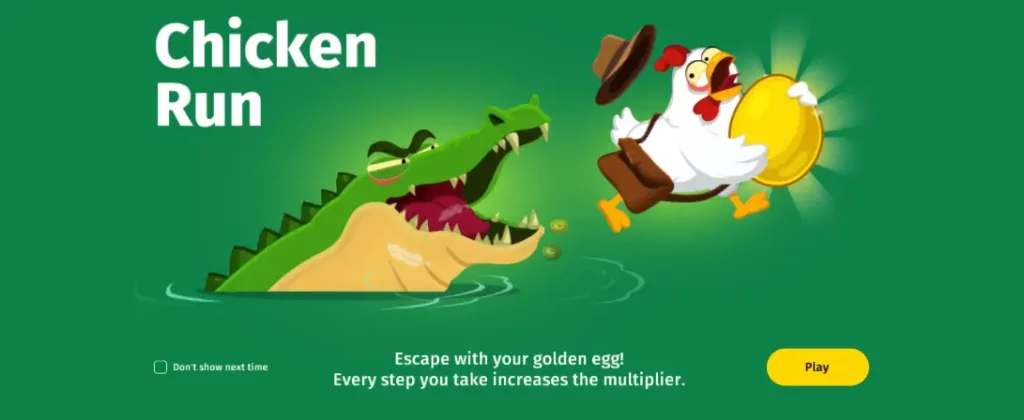
Chicken Run Rules
Visual Design and Interface
PoggiPlay built Chicken Run’s visual environment around a jungle-swamp cartoon aesthetic that communicates the game’s narrative with consistent personality. The chicken character hops across column platforms above implied hazard below — a lurking predator visible in the swamp provides thematic justification for the fail condition without requiring text explanation.
Legibility as design priority: the multiplier ladder is prominently displayed throughout each run, with the current rung position always clearly indicated. Failed attempts signal cleanly — there is no visual ambiguity about whether a hop succeeded or failed. This clarity is a functional requirement for a game where the player’s decision quality depends entirely on accurate state awareness.
Audio design rises with ladder progression — sound effects become more intense as higher rungs are reached, creating an audio dimension to the tension that builds with each successful advance. The audio remains accent rather than distraction, rising to punctuate key moments without competing with the multiplier display for attention.
Performance across screen sizes reflects the HTML5 development foundation and PoggiPlay’s stated focus on mobile compatibility. The single-column interface translates naturally to smartphone portrait orientation, with the advance and bank controls sized for comfortable one-handed thumb operation during transit sessions.
1Win Bonuses for Chicken Run Players
Available bonuses at 1Win provide meaningful practical session support for a game that rewards extended disciplined play:
Welcome bonus — 500% on first deposit. New players receive a major bankroll multiplier from their first deposit. A larger starting balance directly enables the position sizing discipline — 0.5%–1% of bankroll per round — that produces sustainable long-session performance across all four difficulty modes.
Weekly cashback — up to 30%. Net weekly losses receive partial automatic return each week. At 95% RTP, the house edge is the highest in the crash game catalog — consistent cashback provides a meaningful practical offset to the theoretical 5% per-round cost across regular weekly play.
Loyalty rewards. Every bet placed builds toward tier-based benefits including enhanced cashback rates and exclusive access over time.
Review all current terms and wagering requirements before activating any offer, as crash game eligibility may vary by promotion type.
Getting Started at 1Win
Registration takes only a few minutes:
- Visit the 1Win website and click the registration button
- Choose standard signup or social media authorization
- Enter your personal details accurately — required for withdrawal processing
- Confirm your account via email or SMS verification
- Make your first deposit of at least $10 to qualify for the welcome bonus
- Bonus funds activate automatically upon confirmed eligible deposit
Complete identity verification early to ensure smooth processing when withdrawing winnings.
Strategic Approaches for Chicken Run
Chicken Run’s 95% RTP is determined by the random number generator and is not alterable by strategy. What strategy does influence is how outcomes are distributed within a session — specifically how bankroll depletion risk and peak multiplier access interact across many rounds.
Pre-commit to exit rungs before each round. The single most effective discipline tool available in Chicken Run is setting a target rung before clicking advance for the first time and treating that target as non-negotiable. Mid-run renegotiation — “just one more rung” — is the primary mechanism through which the upper ladder’s steep fail probabilities capture money from players who would have banked profitably at a lower rung. Pre-commitment removes this temptation entirely.
Mode-appropriate position sizing. Hardcore mode’s upper rungs carry concentrated risk that can wipe multiple sessions’ worth of modest gains in a single round. Applying smaller stakes to Hardcore runs than to Easy or Medium runs within the same session budget creates proportional exposure relative to per-round variance. A practical approach: Easy/Medium sessions at 1%–2% of bankroll, Hard at 0.5%–1%, Hardcore at 0.1%–0.5%.
Session stop-loss discipline. Define a loss limit for each session before starting and stop regardless of current session narrative when it is reached. Chicken Run’s short round format creates high-frequency decision fatigue — sessions that extend past comfortable duration produce lower-quality decisions at the rung-advance/bank junction precisely when stakes may have increased due to prior losses.
Logging for pattern recognition. Recording rung reached, stake, mode, and result per session across multiple sessions produces a dataset that reveals individual tendencies — which modes produce consistent ruin, which rung targets hold under pressure, which stake levels create emotion-driven deviation from pre-committed targets. This feedback loop is more valuable than any heuristic rule, because it reflects actual behavior under actual conditions.
Modest targets across many rounds. Mathematically, harvesting modest multipliers — rung three to five on Medium, rung two to four on Hard — across a high round volume produces more consistent results than pursuing top-rung outcomes. The variance reduction from consistent early banking outweighs the multiplier sacrifice in expected value terms because late-rung fail probabilities are disproportionately costly relative to the incremental multiplier gains.
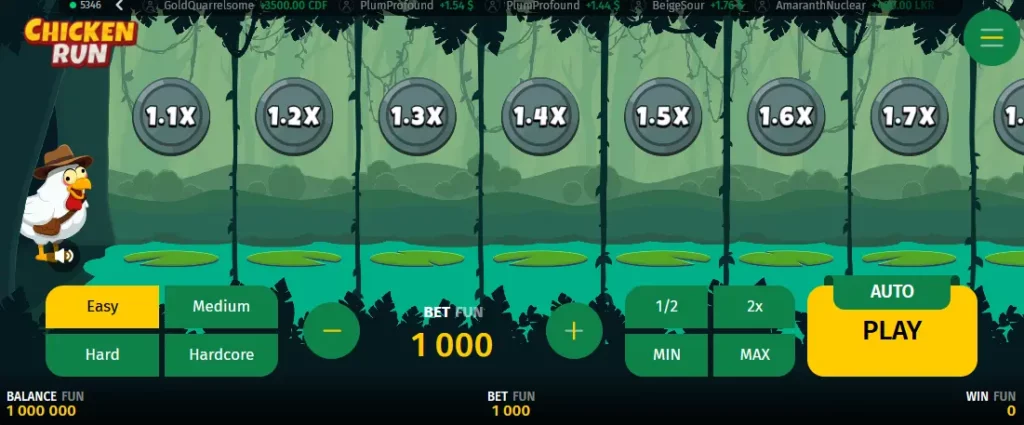
Chicken Run Gameplay
Mobile Experience
Chicken Run runs fully on mobile devices through 1Win’s browser-based access. The turn-based format is exceptionally well suited to mobile play — because no timer is running, there is no performance sensitivity to momentary screen response variation. The advance and bank decision can be made and executed without precision timing, unlike real-time crash games where a 200ms latency difference in tap response can meaningfully affect cash-out outcomes.
The single-track interface fills smartphone portrait screens with the multiplier ladder, chicken position indicator, current stake display, and advance/bank controls all visible simultaneously without scrolling. The clean cartoon visual design remains readable on small screens, and the audio tension-building cues are preserved through device speakers or headphones.
How Chicken Run Compares to Similar Games at 1Win
Chicken Run vs. Rocket Queen. Rocket Queen is a real-time rising multiplier crash game requiring live cash-out timing; Chicken Run is turn-based with no timing pressure. Rocket Queen’s 97.2% RTP significantly outperforms Chicken Run’s 95%. The choice between them is fundamentally about engagement style: reflex-timing under live multiplier pressure versus deliberate rung-by-rung decision-making at a player-controlled pace.
Chicken Run vs. Speed-n-Cash. Speed-n-Cash’s dual-car format provides two simultaneous crash events and a head-to-head betting mode; Chicken Run provides a single ladder run with four difficulty configurations. Speed-n-Cash is real-time; Chicken Run is turn-based. Both are crash-format games but with entirely different pacing and decision structures.
Chicken Run vs. Plinko. Both offer player-controlled risk configuration before commitment — Plinko through row count and volatility selection, Chicken Run through difficulty mode and per-round exit target setting. Plinko’s 99% RTP is substantially stronger than Chicken Run’s 95%. Plinko is fully passive after drop — the ball falls without further player input; Chicken Run requires active decisions at every rung. For players who value ongoing decision engagement over passive outcome resolution, Chicken Run’s turn-based structure is the more intellectually active choice.
Other 1Win Slots
 Oliver Bridgewater

